
Stop Wondering Why Dust Returns So Fast by Finding the Source
What Household Dust Is Actually Made Of and Where It Enters
Many people assume dust is purely dirt from outdoors or exclusively shed skin. In reality, it is a complex cocktail of microscopic debris. A typical home generates roughly 40 pounds of dust each year, according to EPA indoor air quality studies.
About 60 percent of that buildup originates outside. Fine soil particles, atmospheric pollen, vehicle exhaust, brake-pad residue, and industrial drift drift into living areas through open doors, unsealed gaps, and unconditioned spaces. The remaining 40 percent is generated right inside the home:
- Biological material: Human skin scales and microscopic dust mites that feed on them.
- Pet dander: Flakes of shed skin, dried saliva proteins, and pet hair.
- Textile breakdown: Microscopic fibers that shed from clothing, bedding, rugs, and upholstered furniture.
- Paper and household breakdown: Tiny fragments of decomposing cardboard, paper towels, and packaging.
Adopting simple habits for a dust-free, comfortable home helps minimize these materials before they take over your flat surfaces.
| Dust Source | Primary Components | Common Entry / Origin Point |
|---|---|---|
| Outdoor Infiltration (approx. 60%) | Soil, sand, tree/grass pollen, soot, vehicle emissions | Drafty windows, open doors, shoes, unsealed HVAC returns |
| Indoor Shedding (approx. 40%) | Skin cells, pet dander, lint, upholstery fibers, dust mite waste | Living spaces, bedrooms, clothing, pets, upholstered furniture |
Understanding the Root Causes: Why Is My House So Dusty?
When dust settles within hours of cleaning, the underlying issue is rarely a lack of effort. It usually stems from uncontrolled airflow or system filtration gaps.
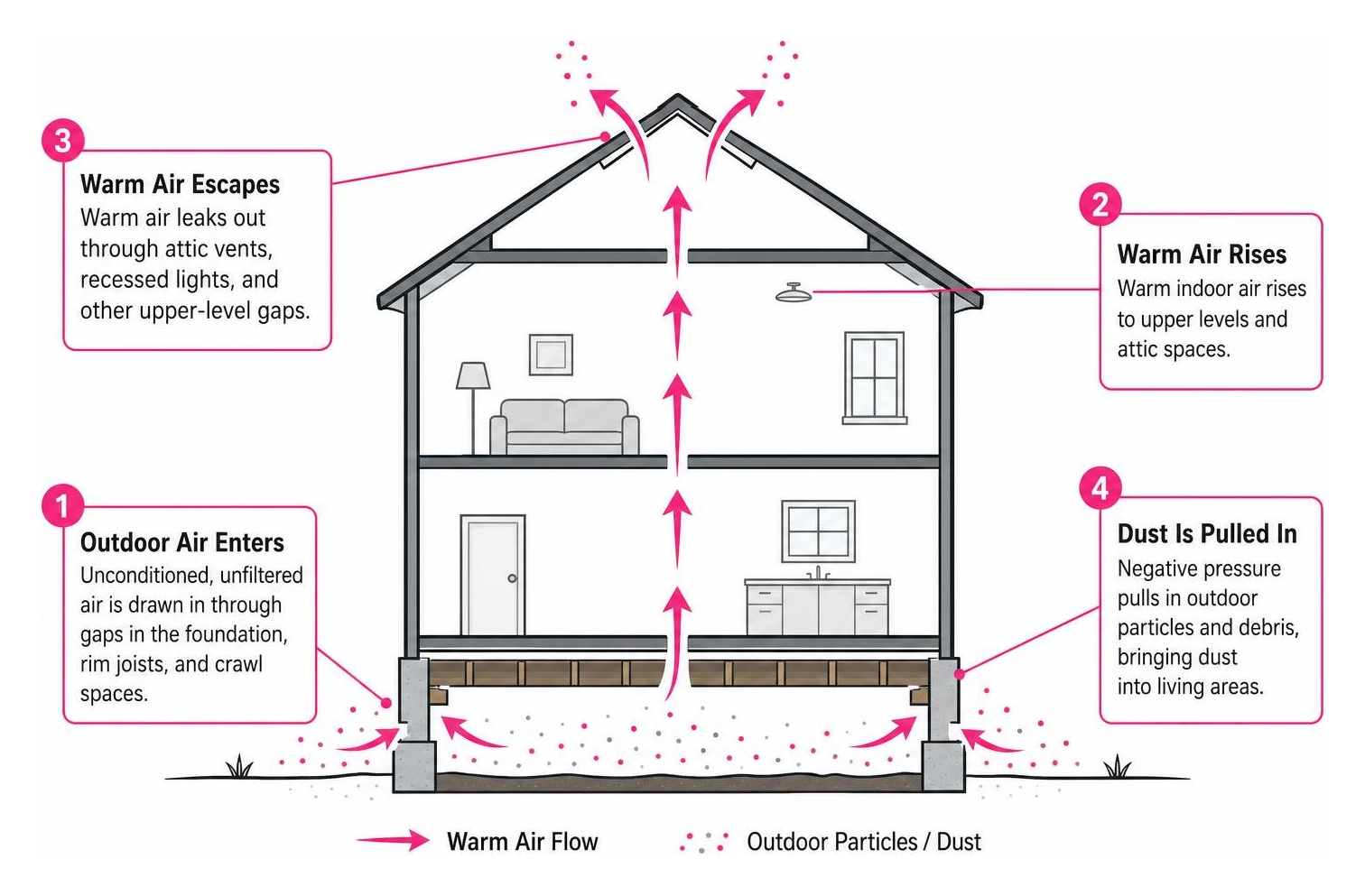
A natural physical process known as the stack effect constantly moves air through your home. Warm air rises and escapes through upper levels, attics, and recessed ceiling fixtures. As that air leaves, it creates negative pressure on the lower levels, pulling in unconditioned, unfiltered air through rim joists, crawl spaces, and foundation gaps. If those lower areas contain loose dirt, insulation fibers, or outdoor debris, the house continuously pulls that dust right into your living areas.
HVAC Filtration Gaps: Why Is My House So Dusty Despite Running the Fan?
Your heating and cooling system acts as the lungs of your home. When working properly, it filters out airborne particles. However, several mechanical oversights can turn it into a dust distribution network:
- Inefficient or Clogged Filters: Standard fiberglass filters only stop large debris from harming the furnace motor. Upgrading to a MERV 8 to MERV 13 rated filter captures much smaller particles. If a filter becomes fully clogged, airflow bypasses the frame entirely, blowing dust straight into your rooms.
- Leaky Return Ductwork: Return ducts often run through unconditioned attics, basements, or crawl spaces. Gaps, loose joints, or unsealed seams pull dusty attic air directly into the HVAC stream before circulating it through supply vents.
- Blower Fan and Coil Buildup: Over years of operation, dust coats the blower motor wheel and evaporator coils. Every time the system kicks on, fine particulate matter blows into living spaces.
Building Envelope Leaks and Humidity Imbalances
Gaps around window frames, deteriorated exterior door sweeps, and unsealed baseboards allow outdoor dust to bypass your home’s exterior walls.
Indoor relative humidity also plays a major role in dust behavior:
- Low Humidity (Below 30%): Dry winter air increases static electricity, causing dust particles to remain suspended in the air longer before clinging stubbornly to televisions, shelving, and hard surfaces.
- High Humidity (Above 50%): Moist air makes dust particles heavier, causing them to settle faster onto surfaces while creating an environment where dust mites thrive.
Balancing indoor relative humidity between 35% and 50% helps airborne particles settle predictably without encouraging moisture issues.
Soft Surfaces, Flooring, and Pets
Carpeting, area rugs, throw pillows, and fabric sofas act as massive dust reservoirs. Every footstep on a carpet or sit-down on an upholstered chair acts like a bellows, launching thousands of trapped fibers and dander particles back into the air.
Pets naturally accelerate this cycle. Even short-haired animals shed dander and track in outdoor dirt. Frequently cleaning high-touch areas and vacuuming high-traffic zones keeps these materials from accumulating to unmanageable levels.
Common Cleaning Mistakes That Spread Dust Instead of Removing It

Cleaning hard surfaces without the right tools often makes a dust problem look worse.
- Using Feather Dusters or Dry Rags: Dry wiping merely launches settled dust into the air. The room looks clean for an hour, but gravity pulls those same particles right back down onto your furniture. Use a lightly dampened microfiber cloth instead; split microfiber weaves hold an electrostatic charge that traps particles securely.
- Using Vacuums Without HEPA Filtration: Standard vacuums without sealed HEPA filtration catch large dirt but exhaust fine particles right back out the rear vent. A true HEPA filter traps 99.97% of particles down to 0.3 microns.
- Cleaning Out of Order: Always clean from top to bottom. Dust ceiling fans, light fixtures, and upper shelves first so that any dislodged debris falls to the floor, where your vacuum can pick it up last.
Reviewing how to master dusting techniques in less than an hour a day helps streamline your routine.
A Step-by-Step Action Plan to Dramatically Reduce Household Dust

To get ahead of dust buildup, combine physical prevention at entry points with better filtration and consistent cleaning habits.
Upgrading Air Quality and Sealing the Envelope
- Upgrade Furnace Filtration: Install a pleated filter rated MERV 8 to 13. Replace it every 60 to 90 days—or every 30 to 45 days if you have multiple pets.
- Seal Air Leaks: Inspect exterior doors and windows. Replace worn weatherstripping and install sturdy door sweeps. Apply paintable caulk along drafts at window moldings.
- Insulate Attic Access: Seal pull-down attic stairs or access hatches with foam weatherstripping to stop attic insulation dust from filtering downward.
- Seal Duct Connections: Inspect exposed ductwork in basements or utility rooms. Seal visible joints with UL-181 rated foil tape or duct mastic (standard cloth duct tape degrades and fails over time). Comprehensive internal duct sealing or duct cleaning requires an HVAC specialist.
- Add Portable HEPA Purifiers: Place standalone HEPA air purifiers in primary living areas and bedrooms to continuously filter out floating pet dander and fibers.
Deep Cleaning and Routine Upkeep
- Establish a Shoes-Off Policy: Since roughly 85% of tracked-in soil enters on shoe treads, placing walk-off mats outside and inside entryways catches outdoor grit at the door.
- Wash Bedding Frequently: Launder sheets and pillowcases weekly in warm water to reduce dust mite populations and human skin cell accumulation.
- Vacuum Hard and Soft Floors Weekly: Slowly pass a sealed HEPA vacuum over high-traffic carpets and rugs twice a week to pull dirt from deep within the pile.
Following a structured weekly guide to maintain a clean home makes it easy to keep these tasks on schedule.
Frequently Asked Questions About Persistent Household Dust
Why is my house so dusty even right after cleaning?
Dusting with dry tools, using a non-HEPA vacuum, or cleaning floors before dusting surfaces causes loose particles to float in the air and settle right back onto your furniture within an hour. Unsealed return air ducts or an HVAC fan running on a clogged filter will also redistribute dust across freshly wiped rooms.
Does carpet hold significantly more dust than hard flooring?
Yes. Carpet pile acts as a deep physical filter, holding substantial amounts of pet dander, tracked-in soil, and broken textile fibers. While hard flooring leaves dust visible immediately, carpet traps it until foot traffic knocks it loose into the air. Regular vacuuming with a strong HEPA unit prevents carpets from becoming overloaded dust reservoirs.
Can running the HVAC fan continuously help clear dust?
Switching your HVAC thermostat fan setting from “Auto” to “On” pulls air through your filter continuously, which can help capture airborne dust. However, this also causes your filter to load with debris much faster, requiring monthly checks. If your ductwork has leaks in unconditioned spaces, running the fan constantly can inadvertently draw in additional dust from attics or crawl spaces.
Conclusion
Managing household dust is an ongoing process that combines home maintenance with smart cleaning techniques. Sealing air leaks, replacing HVAC filters on schedule, controlling indoor humidity, and using damp microfiber cloths all help lower the volume of airborne particles in your living spaces.
When everyday dust and surface buildup become difficult to manage alongside a busy schedule, our team at Affordable Maids is here to help. With over 32 years of experience and more than 279,000 cleans completed across the greater Pittsburgh area, we specialize in thorough, detail-oriented cleaning.
Schedule our recurring maid services to keep your living spaces fresh and comfortable week after week. Personalized service quotes depend on home size, layout, current condition, and optional add-ons like refrigerator-interior or oven-interior cleaning. Reach out to our local team today to get your custom home estimate.