
The Definitive Guide to Where to Start When Your House Is Overwhelming
Where to Start When Your House Feels Overwhelming
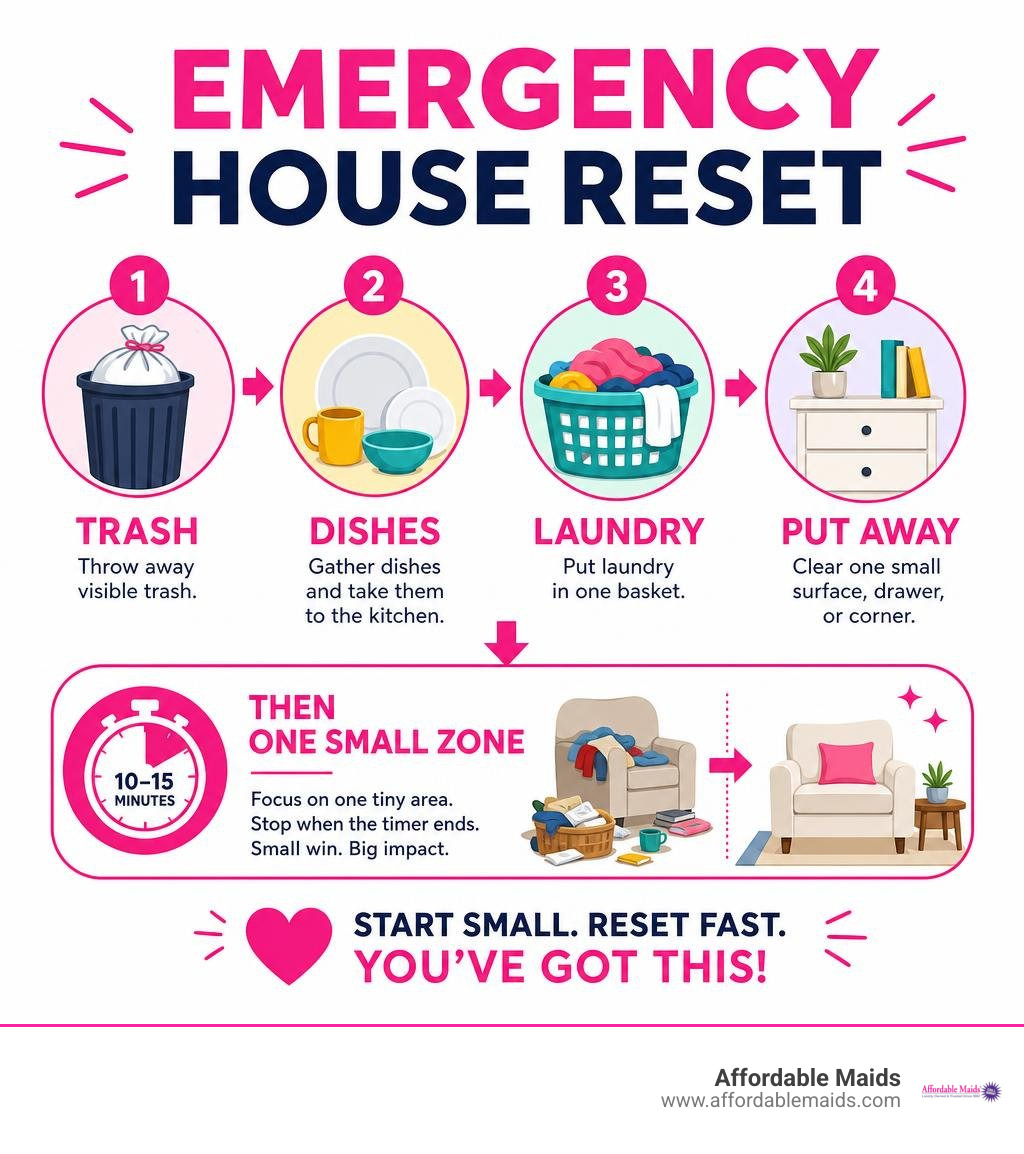
When you do not know where to start when house is overwhelming, do not begin by organizing the whole room. Set a 10- to 15-minute timer and choose one tiny, low-decision task:
- Throw away visible trash.
- Gather dishes and take them to the kitchen.
- Put laundry in one basket.
- Clear one small surface, drawer, or corner.
Stop when the timer ends. A finished drawer or clear counter is more useful than a half-started whole-house project. Start with easy decisions, such as trash, expired products, or items that clearly belong elsewhere. Save sentimental belongings, packed closets, and complicated paperwork for later.
A messy home can create constant visual noise and hundreds of small decisions. That is why freezing is common; it is not proof that you are lazy or failing. Research on clutter and stress has also found that women who described their homes as cluttered showed less healthy daily cortisol patterns.
The goal is not perfection. It is to make one visible area work better, then use that small win to decide what comes next. This guide will help you turn an overwhelming home into a series of manageable steps.
The Psychology of Mess: Why Clutter Triggers Overwhelm
Walking into a chaotic living space can cause an immediate physical reaction. Your chest might tighten, your brain feels foggy, and you suddenly feel exhausted. This is not a personal shortcoming; it is a common stress response. Every single item left out in the open functions like unread visual mail. Your brain keeps registering those stimuli and the decisions attached to them: keep it, move it, wash it, fix it, donate it, or throw it away.

When visual noise reaches a tipping point, it can overtax your executive functioning. You become stuck in analysis paralysis and the familiar freeze response. In scientific research on clutter and cortisol, women whose home-tour language reflected clutter, unfinished projects, or stressful home environments showed less adaptive daily cortisol patterns than women whose language reflected a more restorative home environment. That does not mean every messy room causes the same biological response for every person, but it does help explain why clutter can feel mentally heavier than it looks.
Understanding Where to Start When House Is Overwhelming
The secret to breaking through that mental freeze lies in mental reframing. When your home feels chaotic, subtracting one obvious irritant from your environment can deliver quick emotional relief. A cleared chair, an empty sink, or a trash-free coffee table gives your brain proof that the situation can change.
To lower the barrier to entry, make the first task almost too small to resist. If you tell yourself, “I need to clean the entire ground floor today,” your brain may interpret that as an impossible mountain of effort and shut down. If you tell yourself, “I am going to throw away three candy wrappers and two empty water bottles,” the task feels manageable. By focusing on tiny subtractions, you reduce the number of decisions in front of you and regain a sense of agency.
The Vital Difference Between Tidying, Decluttering, and Deep Cleaning
One of the most common mistakes people make when facing a messy home is attempting to tidy, declutter, and deep clean all at the same time. Doing so practically guarantees project creep. You start wiping down a table, stop to fold a sweater, open a drawer to put it away, decide to reorganize the drawer, and end up sitting on the floor surrounded by three different piles of mess, feeling more defeated than when you started.
To avoid this trap, it helps to establish simple habits for a dust-free home by separating these three distinct jobs:
| Task Type | Core Purpose | What It Involves | When to Do It |
|---|---|---|---|
| Tidying | Restoring baseline order | Returning items that already have a home back to their places | Daily or as a quick reset |
| Decluttering | Reducing physical volume | Discarding, donating, or rehoming excess possessions | When storage areas overflow |
| Deep Cleaning | Removing physical dirt | Scrubbing, vacuuming, wiping down baseboards and surfaces | After clutter is cleared |
Trying to deep clean around piles of clutter is like attempting to mow the lawn while children’s toys and garden hoses are scattered across the grass. Tidying and decluttering should come first so the actual cleaning is easier to complete.
Where to Start When House Is Overwhelming: The Step-by-Step Reset
When your living space feels out of control, you need a linear, step-by-step framework that requires as little thought as possible.
First Steps on Where to Start When House Is Overwhelming
To regain control without burning out, work through the following low-friction sequence:
- The Trash Sweep: Grab a large garbage bag. Walk through the room and pick up only obvious rubbish – wrappers, junk mail, delivery boxes, broken items, and dried-up pens. Do not touch anything else.
- The Dish Run: Gather every cup, mug, plate, and utensil sitting on tables or desks and carry them directly into the kitchen sink or dishwasher. Do not wash them yet; simply centralize them.
- The Laundry Round-Up: Pick up all dirty clothes, towels, and blankets from the floor and furniture. Toss them into a laundry hamper.
- The Four-Box Method for Stragglers: For remaining loose objects, set out four bins or boxes labeled Keep, Donate, Trash, and Relocate. Work on one small surface at a time.

Here are five high-impact micro-tasks you can complete in under 10 minutes:
- Clear and wipe the main kitchen island or center table.
- Empty the small bathroom trash bin and clear the sink rim.
- Gather all shoes from the front door area into a single tray or basket.
- Strip and remake your bed with clean sheets.
- Sort through the top layer of the coffee table.
Low-Emotion Micro-Zones for Quick Wins
To protect your mental energy, always begin where decisions are objective and obvious rather than emotional. Primary research on choice overload and decision-making suggests that having too many options can make decisions feel harder and reduce follow-through. In a messy home, that means low-emotion areas are often the best starting point because the answers are clearer:
- The Medicine Cabinet & Bathroom Drawers: Decisions here are usually straightforward. Empty shampoo bottles, dried-out mascara, and expired sunscreen do not require sentimental debate. For old prescription containers or medication, follow pharmacy or local disposal guidance.
- The Pantry and Fridge: Check expiration dates on salad dressings, sauces, and canned goods. If it expired three years ago, let it go.
- The Junk Drawer: Set aside dead batteries for proper recycling or disposal, and discard broken rubber bands, dried-up highlighters, and mysterious plastic parts to things you no longer own.
- Kitchen Duplicates: If you own five spatulas and four vegetable peelers, pick your favorite two and donate the spares.
Starting in these low-emotion zones lets you build confidence before you ever open a box of family photos or tackle a wardrobe full of clothes.
Proven Action Methods: Timers, the Snowball Effect, and the Five-Category System
If task initiation is where you struggle most, rely on time-tested operational techniques to create momentum:
- The 15-Minute Sprint: Set a kitchen timer for 15 minutes. Promise yourself that as soon as the timer beeps, you have full permission to stop. A short, bounded timeframe lowers resistance and helps eliminate procrastination.
- The Snowball Method: Start with the smallest, easiest physical mess you can find – like clearing a single nightstand. Completing that tiny task gives your brain a quick sense of completion, creating visible momentum that naturally encourages you to tackle the next small area.
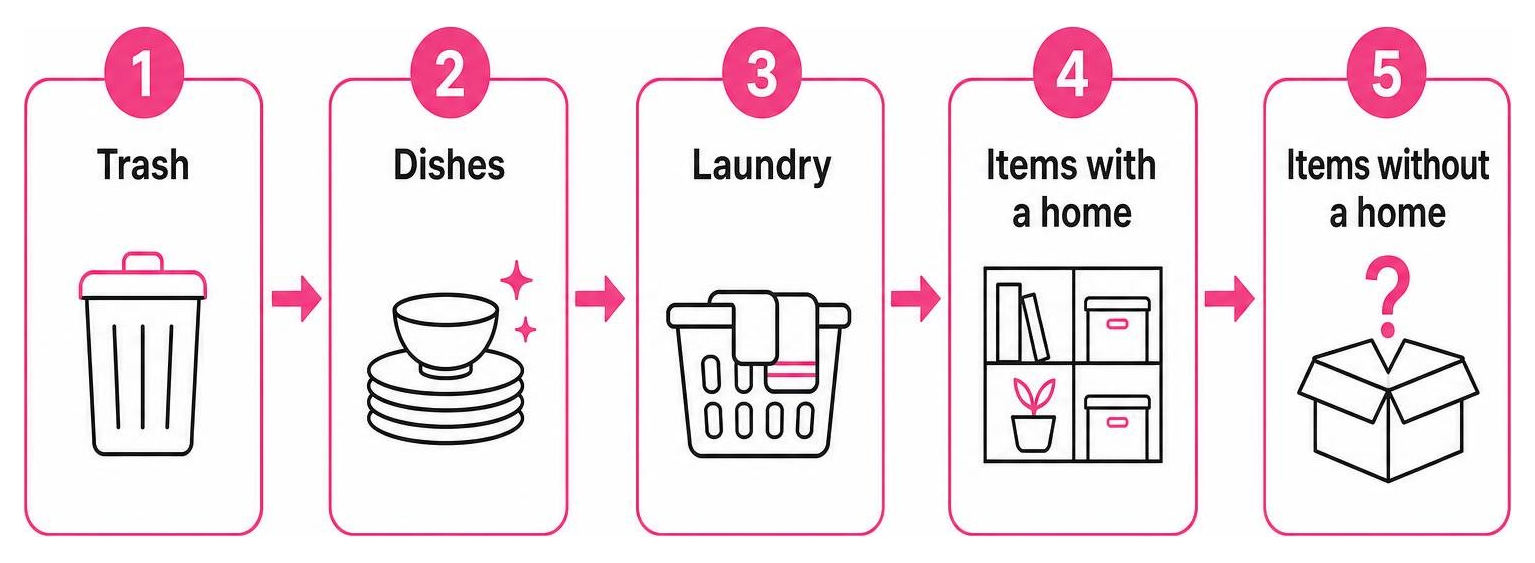
- The Five-Category Sort: In any messy room, everything on the floor belongs to one of only five types: trash, dishes, laundry, things with a home, and things without a home. Address them in that exact order.
Having a systematic cleaning checklist nearby provides a clear roadmap so you never have to wonder what step comes next.
Conquering Decision Fatigue, Perfectionism, and Clutter Guilt
Perfectionism is one of the quickest routes to household paralysis. An all-or-nothing mindset whispers that if you cannot completely organize the entire walk-in closet from top to bottom this afternoon, you shouldn’t bother picking up the shirts on the floor.
Remember: Progress is always better than perfection. A home that is 20% tidier is significantly more functional and relaxing than a home that remains 100% messy while you wait for a free weekend that never arrives.
Clutter guilt also stalls progress. We hold onto useless items because someone gave them to us as a gift, or because we spent hard-earned money on them years ago (the classic sunk-cost fallacy). Remind yourself that an unused item takes up valuable emotional and physical real estate in your home. The money was spent the moment you purchased it; keeping it in a dark closet will not bring those funds back.
Managing Unhomed Possessions and Sentimental Belongings
When you encounter items you do not know what to do with, avoid creating a messy “maybe” pile that ends up sitting around for months. Instead, use the 30-Day Quarantine Box:
- Place questionable items into a cardboard box.
- Seal the box and write a date 30 days into the future on the top.
- Store the box in a closet or garage.
- If you do not open the box to retrieve an item during those 30 days, donate the unopened box.
To prevent daily entryway clutter, establish a dedicated drop-zone with simple hooks, trays, and bins for keys, bags, and daily mail.
Enlisting Family Support and Asking for Help Without Shame
You do not have to shoulder the burden of household maintenance alone. If you live with family members or roommates, frame tidying as a team effort rather than a punishment:
- Age-Appropriate Assignments: Young children can easily sort laundry into darks and lights, gather stray toys into a bin, or wipe down low baseboards with a damp cloth.
- Chore Gamification: Set a lively playlist and challenge the household to see how many items can be returned to their homes before three songs finish playing.
- Body Doubling: If you struggle to stay focused when cleaning alone, ask a friend or partner to simply sit in the room and chat with you while you fold laundry or sort through a closet. Their presence alone can keep you grounded.
Long-Term Maintenance: How to Keep Chaos from Returning
Once you have cleared the initial backlog of clutter, shifting toward simple maintenance prevents the cycle of overwhelm from starting over again.
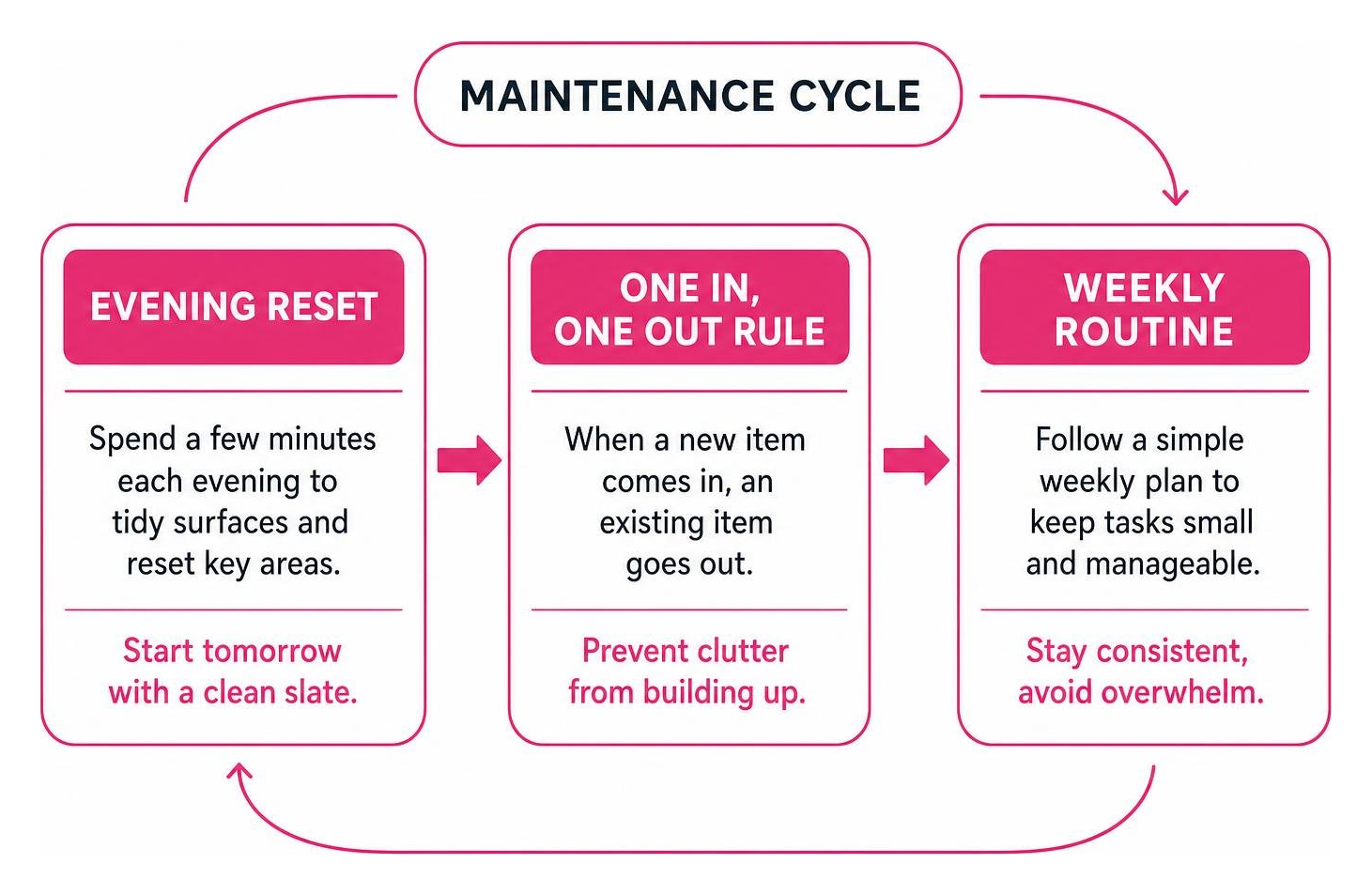
Referencing a practical weekly guide to maintain clean home helps keep your tasks spread out evenly rather than letting chores pile up into a massive weekend ordeal.
Establishing Sustainable Daily Routines
Sustainable home maintenance does not require hours of daily labor. It relies on short, predictable habits stacked onto your existing routines:
- The 10-Minute Evening Reset: Before heading to bed, run a quick ten-minute sweep of the main living areas. Run the dishwasher, wipe the main kitchen counters, and put stray items back in their bins.
- The “One-In, One-Out” Rule: Whenever you bring a new pair of shoes, kitchen gadget, or jacket into the home, let go of an older one to maintain balance.
- Don’t Put It Down, Put It Away: If a task takes less than sixty seconds—such as hanging up a coat, replacing the toilet paper roll, or recycling junk mail—handle it immediately rather than setting it down on a flat surface.
Transitioning from Decluttering to Consistent Home Maintenance
After stripping away excess clutter, you are finally in a position where regular cleaning is easy and fast. When your surfaces are clear, dusting and vacuuming take a fraction of the time.
Many busy homeowners find that combining personal daily reset habits with professional support, such as recurring maid services, provides the ideal balance to keep their living environment fresh and manageable year-round.
Frequently Asked Questions About Cleaning an Overwhelming Home
Should I clean the easiest room or the messiest room first?
Always start with the easiest, lowest-stakes space first—such as a small half-bathroom or a simple hallway closet. Tackling the messiest, most emotionally draining space right away often leads to rapid decision fatigue. Easy wins build visual momentum, boost your confidence, and give you the energy required to handle larger areas later.
What is the fastest way to break cleaning paralysis?
The fastest way to break paralysis is to pair a sensory prompt with an extremely small micro-task. Put on an engaging podcast or favorite playlist, set a timer for 15 minutes, and focus exclusively on filling one bag with trash. Focusing on a single category eliminates the mental strain of deciding what to do next.
What should I do with items that do not have a home?
First, ask yourself honestly if the item is genuinely useful or loved. If it is, assign it a designated container or shelf in the room where it is most frequently used. If you cannot find a logical place for it, it belongs in a 30-day quarantine box or donation bin. Clutter is often just delayed decision-making.
Conclusion
Taking back your home when it feels overwhelming is not about achieving picture-perfect showcase rooms overnight. It is about taking small, intentional steps that reduce everyday stress and give you your living space back. By focusing on tiny micro-zones, utilizing quick 15-minute timers, and separating tidying from deep cleaning, you can create sustainable order without the burnout.
When you have tackled the surface clutter and are ready to hand off the heavy scrubbing, dusting, and floor care to experienced professionals, our team at Affordable Maids is here to help. Contact us to schedule our thorough professional deep cleaning services and enjoy the comfort of a beautifully refreshed home.