
A Practical Guide to Cleaning House More Efficiently
How Professional Cleaners Save Time Without Rushing
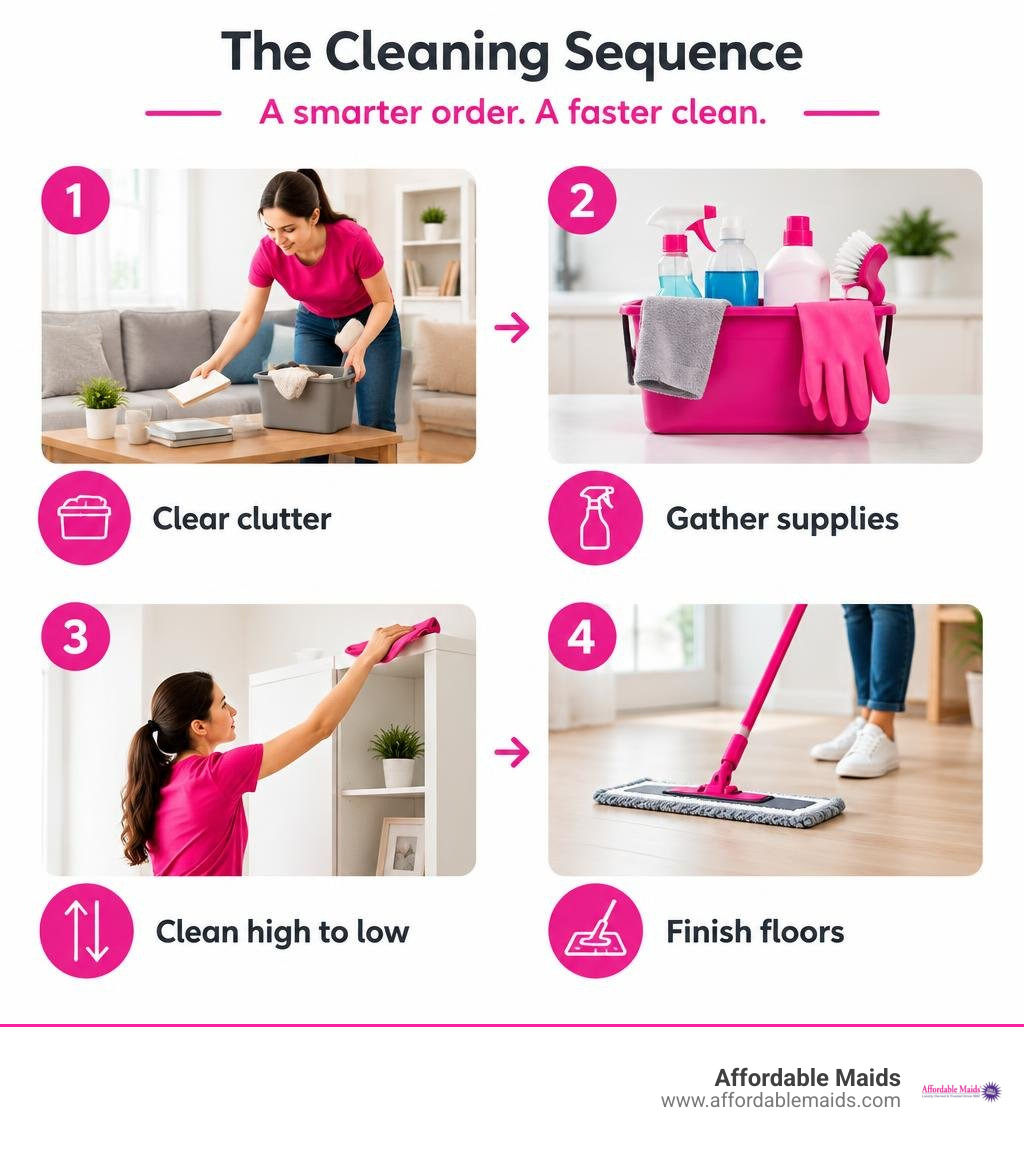
Professional cleaners work faster by following the same route every time. To try it at home, clear clutter first and carry your supplies with you. In each room, clean high surfaces before low ones, work from the far side toward the door, and leave the floor until last. Apply a surface-safe cleaner to stubborn buildup, then let it sit for the time on the label while you handle another task.
That order cuts down on extra trips and keeps dust from falling onto surfaces you have already cleaned. I’m Lynn Reynolds, and I’ll walk you through a routine you can use in your own home.
The Core Systems Behind How Professional Cleaners Clean Faster
Speed in housekeeping is rarely about moving your hands at double speed. It comes down to eliminating wasted steps, unnecessary movement, and redundant tasks. When homeowners tackle a house, they often bounce reactively between visible messes: dusting a coffee table, noticing a dirty dish, walking to the kitchen, wiping the counter, then heading back to finish the living room. This scattered approach wastes physical energy and doubles the time required.
Professional cleaners rely on predictable, repeatable pathways. By establishing a consistent route through each room and across the whole house, you avoid backtracking over surfaces you just wiped down. Understanding the correct order to clean a house allows you to work continuously without pausing to figure out what to do next.
How Top-Down Sequencing Prevents Wasted Motion
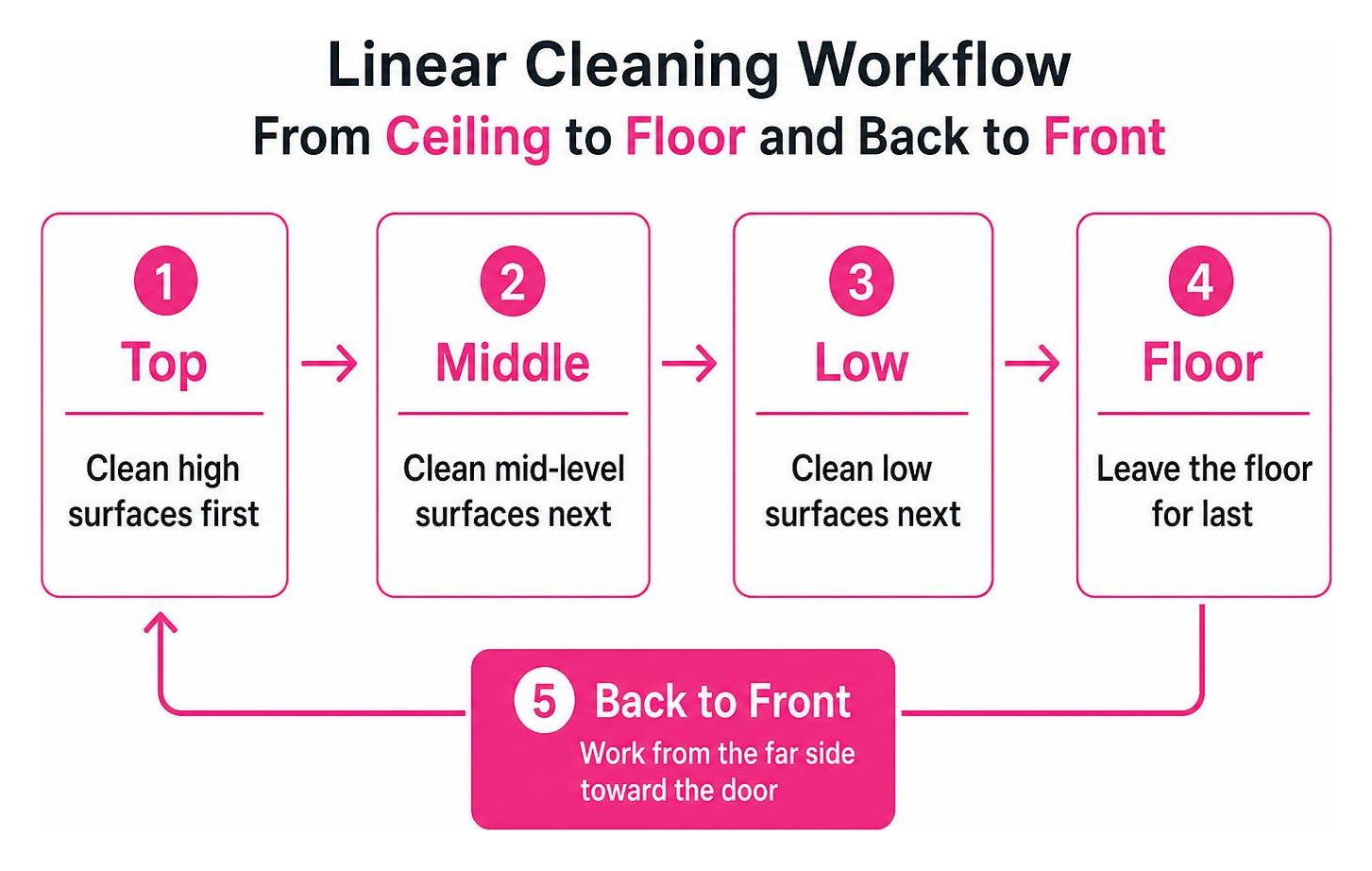
The cornerstone of efficient cleaning is gravity-based sequencing. Dust, crumbs, and airborne particles naturally settle downward as you work. If you vacuum or mop your floors first and then dust your ceiling fans, blinds, and tabletops, you will inevitably have to clean the floors a second time.
Working from top to bottom ensures that every stray crumb or dust bunny lands on a surface that has not been addressed yet. Start by addressing high corners, ceiling fan blades, and light fixtures. From there, move downward to window sills, shelving, and furniture surfaces. Letting loosened dust fall downward means your final floor pass will capture all the debris in a single sweep.
How Zone-by-Zone Focus Speeds Up Whole-House Workflow
In addition to top-down sequencing, professionals utilize a strict back-to-front, zone-by-zone progression. In any given room, begin at the farthest corner from the entrance doorway and systematically work your way around the perimeter toward the exit.
Task batching within defined zones maintains focus and builds momentum. Rather than wandering from room to room, complete all surface-level tasks within one area before finishing its floor and stepping out. Treating each room as a self-contained zone keeps your supplies right beside you and prevents aimless pacing across the house.
Professional Tools and Kit Simplification for Maximum Efficiency
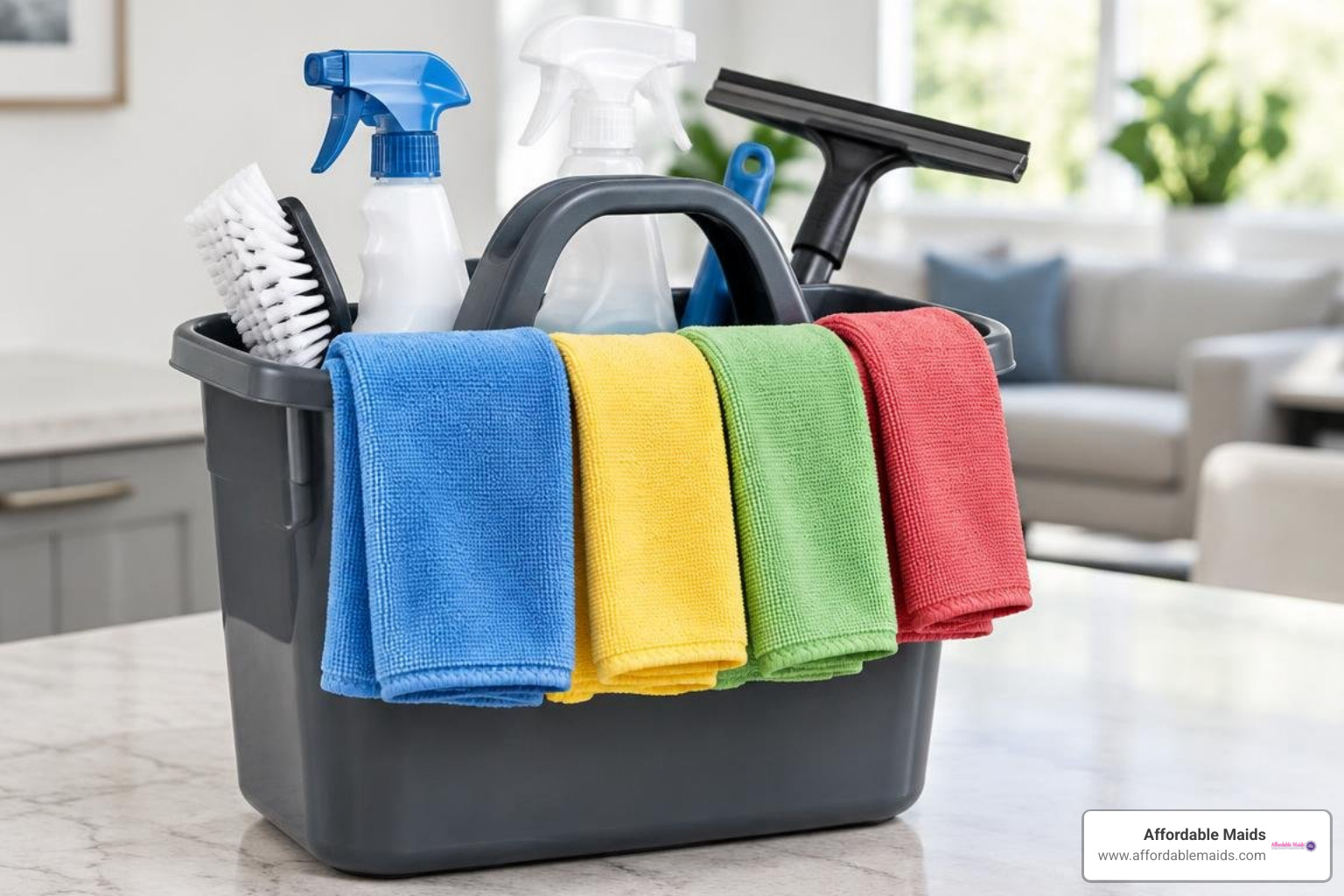
Carrying an armful of mismatched spray bottles and loose paper towels creates clutter and slows you down. If you have to hunt for a glass cleaner under one sink and walk to the laundry room for a scrub sponge, you lose valuable minutes. Organizing your supplies into a mobile caddy that stays at your side keeps your cleaning uninterrupted.
Why Essential Gear Explains How Professional Cleaners Clean Faster
The specific tools you select have a direct impact on physical effort. Professional cleaners depend on durable, high-efficiency equipment designed to capture dirt on the first pass rather than simply spreading it around.
For example, high-quality microfiber cloths trap dust and soil far more effectively than standard cotton rags or paper towels. Microfiber fibers lift and hold dirt particles with plain water or minimal solution, reducing the need for repeated wiping. Pairing microfiber with extension wands allows you to reach high ceiling corners without retrieving a stepladder.
| Professional-Grade Tool | Common Household Alternative | Efficiency Advantage |
|---|---|---|
| High-pile microfiber cloths | Paper towels or old t-shirts | Traps fine dust without leaving lint or requiring repeat passes |
| Long-reach extension duster | Short hand duster / chairs | Reaches ceiling fans, vents, and door frames safely from the floor |
| Lightweight portable caddy | Storing bottles across various cabinets | Keeps all tools and solutions within arm’s reach at all times |
| HEPA-filtration vacuum | Standard bagless upright | Captures microscopic dust rather than blowing it back into room air |
| Stiff nylon detail brush | Large scouring sponge | Quickly loosens grime around faucets and tight fixture edges |
The Simple Kit Strategy: Eliminating Clutter in Your Caddy
You do not need a specialized bottle for every surface in your home. Carrying six different sprays adds unnecessary weight to your caddy and causes decision fatigue. Most residential spaces can be maintained using a streamlined kit:
- Multi-surface neutral concentrate: Diluted properly in water for everyday dusting, spot-cleaning, and hard surfaces.
- pH-neutral floor cleaner: Formulated to lift daily dirt from tile, laminate, or sealed hardwoods without leaving dulling residues.
- Mild abrasive paste or scouring powder: For lifting mineral rings and soap buildup on non-scratch fixtures.
- Grease-cutting dish soap solution: Excellent for breaking down everyday cooking residues and bathroom grime.
- Color-coded microfiber cloths: Green for dusting, blue for mirrors and glass, and yellow or red for bathroom fixtures to keep tasks organized.
Keeping your kit clean, organized, and ready for work at a moment’s notice is a foundational habit that supports every efficient routine.
Tackling High-Effort Rooms: Bathrooms and Kitchens
Kitchens and bathrooms demand the most physical effort because they accumulate sticky grease, dried food splatters, mineral deposits, and soap scum. Rushing into these spaces with a sponge and immediately scrubbing requires significant elbow grease and leads to early fatigue.
Chemical Dwell Time and How Professional Cleaners Clean Faster
The key to cleaning tough areas quickly is letting the chemistry work for you. Every cleaning solution requires a specific “dwell time”—the amount of time the product must sit wet on a surface to break down oils, dissolve residues, or loosen mineral buildup.
When you spray a cleaner and instantly wipe it off, you force your arm muscles to do the work that surfactants were designed to handle. By applying your bathroom or kitchen spray and allowing it to sit according to the manufacturer label (often 3 to 10 minutes), the solution emulsifies grime. When you return, the dirt wipes away with minimal pressure.
Streamlining Kitchen and Bathroom Speed Routines
An efficient routine in these high-effort spaces follows a clear timeline:
- Clear the countertops: Place loose items into temporary bins or out of the splash zone.
- Pre-treat high-grime areas: Spray shower walls, tub basins, sinks, and kitchen cooktops with the appropriate surface-safe cleaner. Apply toilet bowl cleaner under the rim.
- Work top-down on dry tasks: While the spray dwells, dust upper light fixtures, wipe down mirrors, and dust cabinet exteriors.
- Wipe and rinse: Return to the pre-treated surfaces. Wipe shower walls from top to bottom, scrub the toilet bowl with a brush, and wipe kitchen counters using overlapping, S-pattern strokes to avoid missing spots.
- Polishing fixtures: Use a clean, dry microfiber cloth to buff chrome faucets and sink basins to a dry finish.
- Exit with the floor: Sweep out loose hair and crumbs before mopping your way backward out the doorway.
Using a comprehensive home cleaning checklist ensures you address every necessary surface without getting caught in time-consuming side quests.
Common Mistakes That Slow Down Non-Professional Cleaners
Many well-intentioned homeowners spend hours cleaning only to feel that their efforts took too long or did not produce lasting results. Most time loss stems from simple procedural errors rather than a lack of effort.
Cleaning Around Clutter Instead of Staging Spaces First
Attempting to wipe a counter while picking up mail, moving spice jars, and sorting toiletries grinds your cleaning rhythm to a halt. Every time you stop to decide where an object belongs, you lose focus.
Before opening a single cleaning bottle, walk through the space to stage it. Clear counters, pick up floor items, and place out-of-place belongings into a temporary laundry basket. Getting surfaces bare beforehand lets you wipe broad areas in smooth, continuous motions. Developing simple habits to maintain a consistently clean home makes this prep step faster every week.
Misusing Cleaning Products and Skipping Surface Prep
Using more product does not equal a cleaner surface. Modern detergents and liquid cleaners are highly concentrated; using too much leaves a sticky film that actually attracts fresh dust and shoe grime faster.
Always follow basic cleaning safety and efficiency protocols:
- Read label instructions: Follow recommended dilution ratios and contact times strictly.
- Sweep before you vacuum or mop: Running a broom along baseboards and clearing large debris protects vacuum brush rolls and prevents clogs.
- Ensure adequate ventilation: Keep doors and windows open or run exhaust fans when using household cleaning solutions.
- Never mix chemicals: Combining products—such as bleach with ammonia, vinegar, or acids—creates dangerous, toxic vapors.
- Avoid over-saturating surfaces: Spray solution directly onto your cloth rather than soaking drywall, electronic panels, or delicate wood finishes.
Creating a Fast, Sustainable Cleaning Routine at Home
Efficiency is sustained through consistency. When spaces go weeks without attention, oils harden, dust compacts, and soap residue thickens, turning a routine wipe-down into a heavy scrub. Establishing a regular cadence keeps buildup light and manageable.
Setting Boundaries and Realistic Cleaning Goals
You do not need to clean the entire home top to bottom every single day. Professional speed comes from clear task scoping and avoiding perfectionism. By building a cleaning schedule you can stick to, you can divide tasks logically across days or weeks:
- Daily reset: Load the dishwasher, wipe down kitchen prep surfaces, and clear high-traffic counters.
- Weekly routine: Dust high-to-low, wipe bathroom surfaces, empty trash bins, and vacuum/mop floors.
- Periodic deep tasks: Address interior appliance surfaces, baseboard wiping, and detailed surface refreshing on a rotating schedule.
Keeping expectations realistic prevents cleaning fatigue from derailing your routine.
Frequently Asked Questions About Efficient House Cleaning
What is the single biggest time-saver in professional house cleaning?
The biggest time-saver is working top-to-bottom and back-to-front without backtracking. By following a structured pathway around each room, you prevent falling dust from settling on clean surfaces and eliminate unnecessary steps across the house.
How does product dwell time reduce scrubbing effort?
Cleaning solutions contain surfactants and active agents designed to break down oils, grime, and mineral films. Giving the product a few minutes of dwell time on the surface allows the chemical formula to loosen buildup, meaning you only need a light wipe rather than heavy mechanical scrubbing.
Why should you declutter before starting any cleaning routine?
Decluttering clears the physical path so you can wipe countertops, dust furniture, and clean floors in continuous, uninterrupted passes. Sorting through personal belongings while trying to clean breaks your focus and significantly increases the total time spent.
Conclusion
Cleaning your home faster is entirely achievable when you trade random scrubbing for systematic routines. By clearing clutter first, carrying a streamlined kit, respecting product dwell times, and following a strict top-to-bottom path, you can keep your living spaces refreshed in a fraction of the time.
When busy schedules or life events make it difficult to keep up with household upkeep, bringing in professional support can help maintain balance. At Affordable Maids, we provide dependable, comprehensive care to keep local households comfortable and well-maintained. Contact our team today to learn more about our recurring maid services and receive a personalized quote tailored to your home’s layout and cleaning needs.